


The Hospital Consumer Assessment of Healthcare Providers and Systems (HCAHPS) is a national survey that captures patient experience feedback on their hospital stay. With over 7,000 responses received daily, these results are critical in establishing a hospital’s reputation and can impact federal reimbursement through CMS’s Value-Based Purchasing Program.
We consulted with healthcare and hospital leaders in Virginia to understand how they boost their patient experience and HCAHPS scores. Our team outlined 5 strategies to move the needle, focusing on actionable tactics to monitor patient satisfaction.
Looking for ways to streamline your institution? VHHA Solutions helps hospitals and healthcare facilities optimize their performance, from data analytics and financial reporting to patient safety. Talk to our team to learn how our partners can help.
5 Tips to Improve Patient Care Services
- Check Benchmarks to Identify Focus Areas
- Streamline Communication After Discharge
- Consider Patient Experience Feedback From Multiple Channels
- Build Rapport With Patients
- Make Patient Experience & Satisfaction a Core Value
1. Check Benchmarks to Identify Focus Areas
Before launching new initiatives, it’s critical to know where your hospital stands to pinpoint growth opportunities. The Virginia Hospital & Healthcare Association (VHAA) Patient Experience Data Dashboard compiles HCAHPS scores from Virginia hospitals into an interactive dashboard that allows users to:
- Compare a specific hospital’s HCAHPS scores to the state and national average
- See where your hospital ranks among other Virginia hospitals within a given domain
- Compare all Virginia hospitals’ HCAHPS scores in a given domain to those of other states
- Review how a facility’s HCAHPS score has changed over time for a given domain
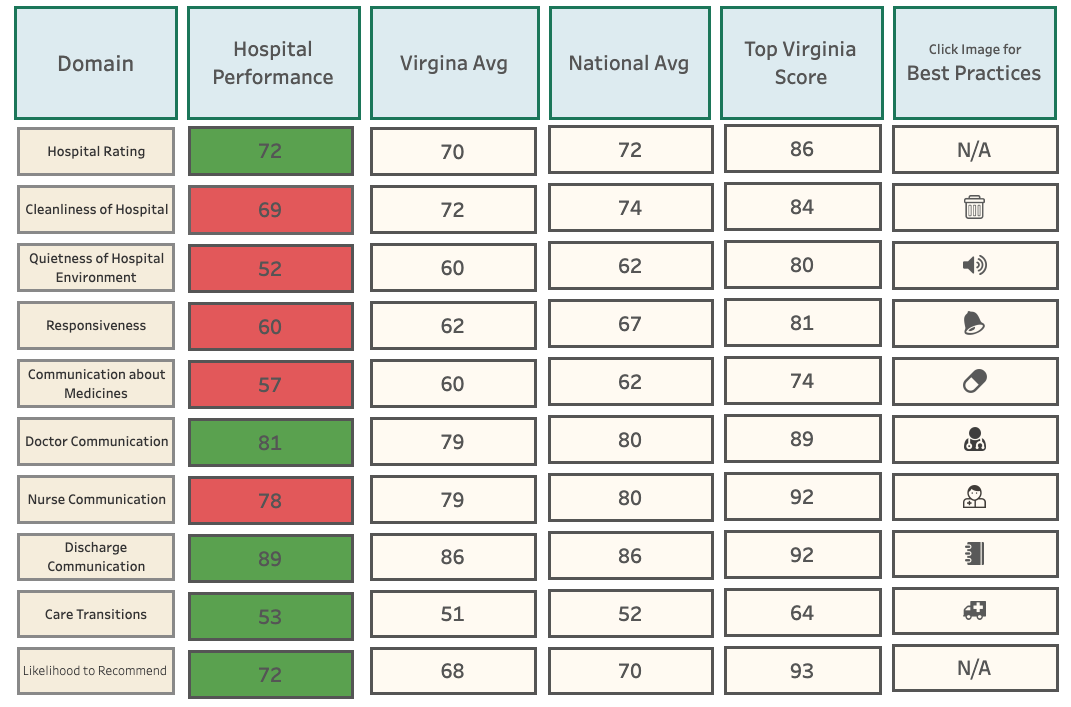
The Faculty Executive Snapshot view (shown below) helps hospital leaders gauge their organization’s performance quickly by highlighting domains with scores below the national average in red. Look for domains with the largest gaps and that have the greatest impact on patient experience to begin developing an improvement plan.
2. Streamline Communication After Discharge
Multiple studies have found that proper follow-up communication after patient discharge can have a positive effect on patient satisfaction scores and reduce readmission rates. Best practices suggest that hospital staff should reach out to patients within 24–48 hours of being discharged, but staff bandwidth constraints can make it challenging to communicate consistently at scale.
One solution is to outsource initial outreach to companies such as SCP Health. Their experienced team of clinical and non-clinical patient navigators works with hospitals to follow up with discharged patients. Care coordinators can also help set up remote patient monitoring (RPM) equipment as needed to automatically collect vital data.
The key benefits of an outsourced partner include:
- Turn-key scripts, procedures, appointment scheduling, and escalation protocols based on proven success with past patients.
- Hospital staff are only involved in call escalations, which affords them more time to focus on high-impact work.
- Patients are provided with written follow-up care instructions and have access to a human coordinator for questions, concerns, or alarming symptoms.
- Remote patient monitoring allows for increased patient data visibility and automated alerts.
3. Consider Patient Feedback From Multiple Channels
Patients often talk about their hospital experience through multiple channels, including social media, discussion forums, and Google or Apple Maps reviews. These comments typically provide more detail than the HCAHPS scores, especially when talking about specific events. Get creative to find actionable feedback about patient satisfaction.
Feedback channels to look at:
- Monitor social media comments and map reviews about your hospital to flag if there are consistent issues. When responding to comments, do so graciously to resolve the issue.
- Explore forums such as Reddit, Quora, and Facebook Groups for mentions of your hospital and gauge the sentiment. Address consistent patterns with your team.
- Incorporate your own patient surveys into your discharge communication to catch early signs of problems before they grow. A greater response rate means better data to work from.
4. Build Rapport With Patients
Considering that five out of 10 domains in the HCAHPS survey relate to communication and responsiveness, it’s clear that hospitals need to understand how to effectively engage with patients beyond providing exceptional care. After all, patients are more likely to cooperate with treatment when they trust your team.
Focus on intentional ways to build patient rapport:
- Lead with empathy when speaking. Patients are often afraid or in pain, so it’s important to recognize their feelings while communicating what they need to hear.
- When appropriate, deliver news at eye level to reassure patients. Sometimes, that means sitting with them.
- Use the patient’s name and ask open-ended questions to start. Listen without rushing to help them feel heard.
- Before finishing check-ins, ask and address patient concerns. You never know what’s on someone’s mind without asking.
- When communicating procedures or treatments, walk the patient through what will happen and their options clearly to manage expectations early on.
5. Make Patient Experience & Satisfaction a Core Value
Sustainable long-term improvements to HCAHPS scores require a hospital work culture that prioritizes patient satisfaction as a core value. Patient interactions must be guided by a desire to promote the patient experience, regardless of role.
- Employ customer service, de-escalation, and culturally appropriate communication training to help patient-facing staff better navigate tough situations.
- Incorporate multiple checkpoints with patients throughout a hospital stay to assess their experience. This helps patients feel heard and gives them opportunities to raise concerns.
- Schedule time for regular leadership rounding, an exercise that allows hospital stakeholders to walk through departments and gain first-hand insights about what goes into patient care. This enforces a top-down and bottom-up culture around patient satisfaction.
- Invest in mental health and wellness resources such as SafeHaven to support your healthcare staff. A burnt-out workforce is less likely to have the capacity to prioritize patient experience.
- Reinforce the value by recognizing high performers and sharing positive patient feedback in team settings.
Work With VHHA Solutions to Increase Your HCAHPS Scores & Patient Experience
A hospital’s HCAHPS performance is only one key indicator of its patient experience. Use the data as a guide to identify high-impact opportunities such as post-discharge touchpoints, staff communication and empathy development, and responsiveness. Improving the patient experience requires a hospital culture that prioritizes patient care at every level. Work with VHHA Solutions to partner with industry leaders in patient satisfaction and raise your HCAHPS scores.