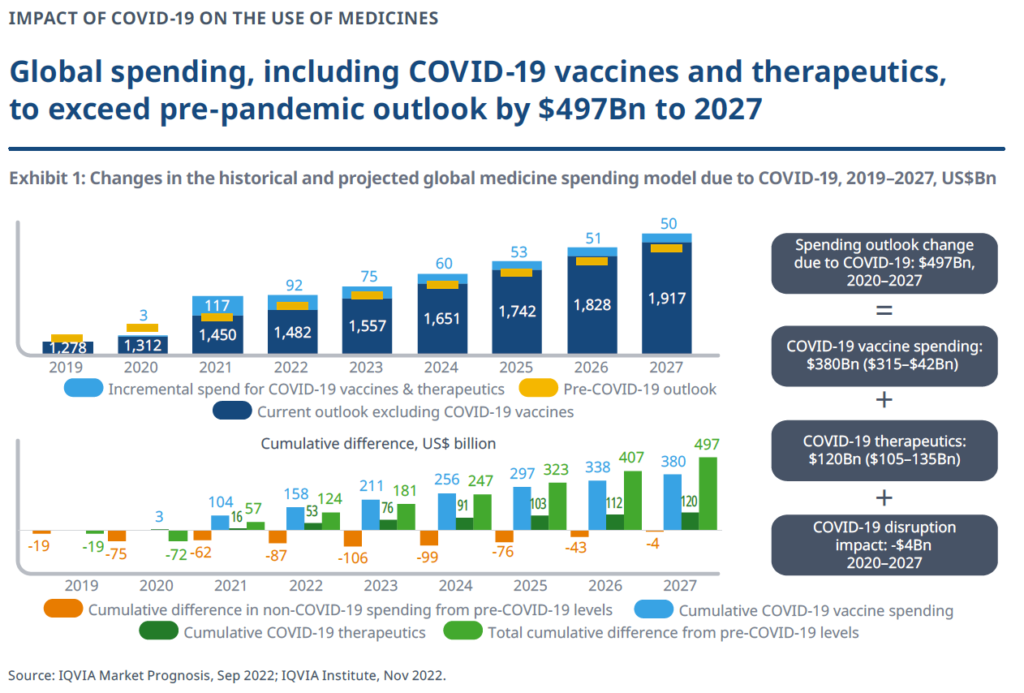

Reaching a post-pandemic era is an alluring prospect for almost everyone around the world after the disruptions of the past three years. The outlook for global spending on medicines has become clearer as the traumas recede and uncertainties give way to more predictable challenges. Policymakers across developed and emerging economies are shifting from crisis to rebuilding modes with a focus on longer-term issues of sustainability. Complex trade-offs remain, and improved efficiency and quality of healthcare informed by evidence-based decision-making will inform the critical decisions in the coming decade.
The largest driver of medicine spending through the next five years is still expected to be global COVID-19 vaccinations, but leaving aside the pandemic, global spending on medicines continues to be driven by innovation and offset by losses of exclusivity and the lower costs of generics and biosimilars.
In its report, The Global Use of Medicines 2023 (Outlook to 2027), the IQVIA Institute for Human Data Science quantifies the impact of these dynamics and examines the spending and usage of medicines in 2022 and the outlook to 2027, globally and for specific therapy areas and countries. It intends for this report to provide a foundation for meaningful discussion about the value, cost, and role of medicines over the next five years in the context of overall healthcare spending.
Key findings:
- The COVID-19 pandemic continues to impact pharmaceutical markets globally, and is estimated to expand the net cumulative pharmaceutical market by $500 billion from 2020 through 2027
- Highest volume growth is expected in Latin America, Asia and Africa, driven by a mix of population growth and expanded access. North America and Europe will see very low growth
- Demand for innovative drugs will drive oncology spending to approximately $370 billion by 2027, almost double the current level
- Biotech will represent 35% of spending globally in 2027 and will include both breakthrough cell and gene therapies, as well as a maturing biosimilar segment
The study was produced independently by the IQVIA Institute for Human Data Science as a public service, without industry or government funding. The contributions to this report by Mohit Agarwal, Aurelio Arias, Urvashi Porwal, Jamie Pritchett, Sarah Rickwood, Priya Srivastava, Durgesh Soni, Alan Thomas, and dozens of others at IQVIA are gratefully acknowledged.
To learn more visit The IQVIA Institute here or view the entire report here.